

Dry Needling vs Acupuncture: What's the Difference?
23/09/26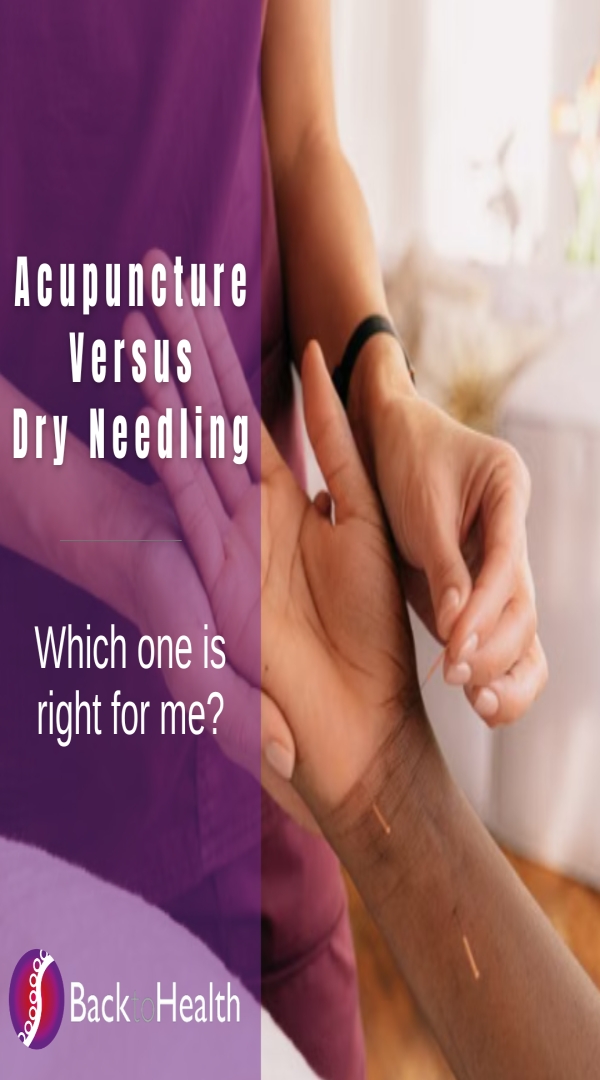
Have you ever wondered what the difference is between Dry Needling and Acupuncture?
If you've visited one of our Back to Health clinics, you may have noticed that both our musculoskeletal practitioners and Acupuncturists use very fine needles as part of their treatments.
It's a question we often hear from patients: "Aren't Dry Needling and Acupuncture the same thing?"
Although both treatments use similar needles, they have different approaches and can be used for different reasons.
At Back to Health, we're fortunate to offer both treatments as part of our multidisciplinary approach to healthcare, helping us provide the care and support that's most appropriate for your individual needs.
Let's take a closer look at what each treatment involves and how they may help you.
What Is Dry Needling?
Dry Needling is a treatment technique used by appropriately trained healthcare professionals, including Chiropractors, Osteopaths and Physiotherapists, to help manage certain types of muscular pain and discomfort.
It involves inserting very fine, sterile needles into specific areas of muscle, often targeting what are known as trigger points.
Trigger points are sensitive areas within a muscle that may feel tight or tender and can sometimes contribute to pain, stiffness and restricted movement.
You may have experienced this yourself when a particular area of muscle feels unusually tight or tender to touch, especially after exercise, spending too long at your desk or carrying out repetitive activities.
Dry Needling aims to stimulate these areas and may help reduce muscle tension, ease discomfort and improve movement.
Some people experience a brief twitching sensation in the muscle during treatment, while others may feel a dull ache or very little sensation at all.
How Do We Use Dry Needling at Back to Health?
At Back to Health, Dry Needling may be incorporated into your Chiropractic or Osteopathy treatment where your practitioner feels it could be beneficial.
For example, if you're experiencing neck or back pain and muscle tension is contributing to your discomfort, Dry Needling may be used alongside other treatment techniques to help address the affected muscles.
It may also be considered for certain sports-related muscular problems or persistent areas of muscle tightness.
However, Dry Needling isn't something every patient needs, and it won't necessarily be included in every appointment.
Your practitioner will assess your symptoms and discuss whether it may be a suitable addition to your treatment plan.
Our aim is always to help your body move and function at its best, using the combination of treatment techniques that is most appropriate for you.
What Is Acupuncture?
Acupuncture has been practised for thousands of years and is an important part of Traditional Chinese Medicine (TCM).
Although it also involves inserting very fine needles into the body, its traditional approach is different from Dry Needling.
Traditional Chinese Medicine is based on the belief that our health and wellbeing are influenced by the balance and flow of energy, known as Qi (pronounced 'chee'), through pathways in the body called meridians.
According to TCM principles, stimulating specific acupuncture points along these pathways is believed to help restore balance and support the body's natural processes.
These traditional concepts provide the framework for TCM acupuncture, although meridians and Qi have not been established as anatomical structures or measurable forms of energy by modern science.
How Do We Use Acupuncture at Back to Health?
Our Acupuncturists take a holistic, person-centred approach, looking at your overall health and wellbeing rather than focusing solely on one particular area of discomfort.
Your initial appointment will involve discussing your symptoms, medical history, lifestyle and general health to help your practitioner understand your individual needs.
Acupuncture may be considered for a range of concerns, including:
-
Certain types of persistent pain and muscular discomfort.
-
Tension-type headaches and migraines.
-
Stress-related symptoms and general wellbeing.
-
Sleep difficulties.
The strength of scientific evidence varies depending on the condition being treated. Acupuncture has evidence supporting its use for some pain conditions and headaches, while research into its effectiveness for other concerns is more limited.
Your Acupuncturist will discuss your symptoms and treatment goals with you to help determine whether Acupuncture may be appropriate.
As with all our treatments, our aim is to provide care that is tailored to you, helping you feel better and supporting your overall health and wellbeing.
Similar Needles, Different Approaches
One of the main reasons people confuse Dry Needling and Acupuncture is that both treatments use very similar equipment.
Both involve the insertion of fine, sterile, single-use needles into specific areas of the body, but there are some important differences in how and why they are used.
Dry Needling
- Primarily focuses on muscular pain, tension and movement.
- Often targets specific muscles and trigger points.
- Based on anatomical and musculoskeletal assessment.
- May be incorporated into Chiropractic, Osteopathy or Physiotherapy treatment.
Acupuncture
- Traditionally takes a broader approach to health and wellbeing.
- Uses acupuncture points selected according to the practitioner's assessment.
- Traditional Acupuncture is based on TCM principles and an individual health assessment.
- Usually provided as a dedicated Acupuncture appointment.
Although the traditional explanations and assessment methods differ, there can be some overlap in the techniques used and the conditions treated.
Both approaches may be used to help manage certain types of pain, and both should be delivered by appropriately trained practitioners.
Which Treatment Is Right for You?
The most appropriate treatment will depend on your symptoms, overall health and what you're hoping to achieve.
If you're experiencing muscle tightness, back or neck pain, or discomfort that's affecting your movement, Dry Needling may be a useful addition to your Chiropractic or Osteopathy treatment.
If you're interested in a Traditional Chinese Medicine approach to managing certain symptoms or supporting your general wellbeing, Acupuncture may be something you'd like to explore.
However, there's no need to decide which treatment you need before speaking to us.
At Back to Health, we understand that everyone's body is different, and what works well for one person may not be the most appropriate approach for another.
Our practitioners will take the time to listen to your concerns, assess your individual needs and discuss the treatment options available to you.
And because we offer a range of healthcare services under one roof, our team can work together where appropriate to help you get the most from your care.
We're Here to Help You Feel Your Best
Whether you're struggling with persistent muscle tension, experiencing recurring headaches or simply looking for ways to support your health and wellbeing, our friendly team is here to help.
At Back to Health, we offer both Dry Needling and Acupuncture alongside our Chiropractic, Osteopathy, Physiotherapy and other complementary treatments.
Our multidisciplinary approach means we can help you explore the treatment options most appropriate for your individual needs, with the aim of helping you move better, feel better and continue enjoying the things you love.
Not sure whether Dry Needling or Acupuncture is right for you?
Speak to one of our friendly team members at our Wrexham, Mold or Chester clinics. We'll be happy to answer your questions and help you find the right starting point.
We currently offer Dry Needling in our Wrexham and Chester clinics and Acupuncture in our Wrexham and Mold clinics.
Visit www.back-to-health.co.uk to find out more about our treatments or book an appointment.
Here's to moving better, feeling better and living healthier lives!
Did you know?
The BPS (Bio psycho social) model proposes that health is best understood in a combination of biological, psychological and social factors rather than purely biological (medical) ones. Our chiropractors follow an evidence based, patient centred BPS model for all our care