


Unsettled Babies: Why Is My Baby Struggling to Settle, and Can Osteopathy Help?
06/11/26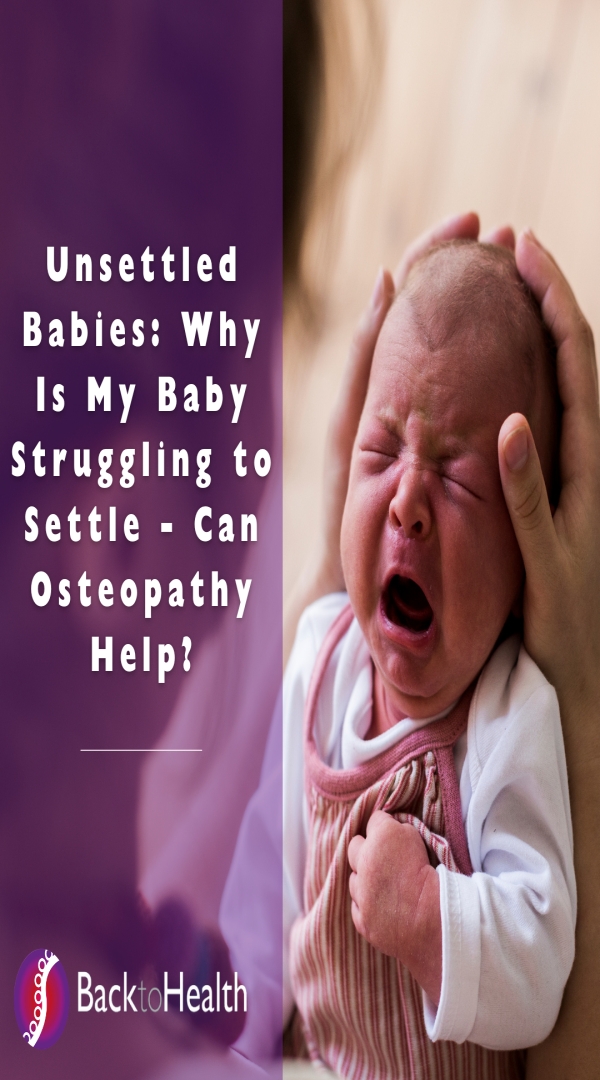
Having a new baby is wonderful, but let's face it, those first few months can also be exhausting!
You're getting to know your little one, adjusting to sleepless nights and trying to work out what they need. But what happens when your baby seems uncomfortable, cries frequently or just won't settle, no matter what you try?
It's something many parents experience, and it can be upsetting when you can't work out what's wrong.
All babies cry, and some need more reassurance than others. However, if your baby regularly seems uncomfortable, struggles with feeding or prefers being held in certain positions, it's understandable that you might start looking for answers.
At Back to Health, we have Osteopaths with additional paediatric training across our clinics, offering specialist assessments and appropriate care for babies and children.
So, what might be making your baby unsettled, and when could a paediatric osteopathy assessment be helpful?
Why Is My Baby So Unsettled?
There's no single reason why babies become unsettled. Sometimes it's something straightforward, such as hunger, tiredness or needing a cuddle. Other times, there may be several things contributing to their discomfort.
Some common concerns parents notice include:
-
Frequent crying, particularly during the afternoon or evening.
-
Difficulty settling after feeding.
-
Arching their back or pulling their knees towards their tummy.
-
Wind, reflux or apparent digestive discomfort.
-
Struggling to latch or becoming frustrated during feeds.
-
Always turning their head towards one side.
-
Seeming uncomfortable when lying flat or being placed in their car seat.
These signs don't necessarily mean there's anything wrong, but if you're concerned about your baby's comfort or behaviour, it's worth speaking to your health visitor or GP.
Let's look at some of the reasons babies may struggle to settle.
1. Reflux and Feeding Discomfort
Reflux is very common in young babies. It happens when milk travels back up from the stomach into the food pipe, sometimes causing your baby to bring milk back up after feeding.
Some babies are perfectly happy despite bringing up milk regularly. Others may become distressed during or after feeds.
You might notice frequent swallowing, coughing, crying or back arching, although these symptoms don't automatically mean your baby has reflux.
For most babies, uncomplicated reflux improves naturally as they grow.
However, if your baby is struggling to feed, seems particularly distressed or isn't gaining weight as expected, it's important to speak to your GP or health visitor.
Can osteopathy help?
Osteopathy isn't a proven treatment for reflux itself. However, an Osteopath with paediatric training can assess your baby's general movement, positioning and musculoskeletal comfort to see whether there are any concerns that may need attention.
2. Colic and Excessive Crying
If your baby cries for long periods, often at similar times each day, you may have heard the term colic.
Colic is commonly used to describe excessive crying in an otherwise healthy baby, particularly during the first few months.
Your baby might clench their fists, draw their knees towards their tummy, go red in the face or seem difficult to comfort.
Nobody fully understands why some babies experience colic, although it usually improves naturally by around three to four months of age.
It's important to remember that not all excessive crying is colic. If your baby's crying is unusual, persistent or accompanied by other symptoms, seek medical advice rather than assuming they'll grow out of it.
3. Feeding and Latching Difficulties
Feeding doesn't always come easily, whether you're breastfeeding or bottle-feeding.
Some babies struggle to latch comfortably, frequently pull away during feeds or seem to prefer feeding from one side.
You might also notice clicking noises, milk dribbling from their mouth or frustration when trying to feed.
There can be several reasons for these difficulties, including feeding position, attachment, milk flow and oral function.
A qualified breastfeeding or infant-feeding specialist is the best starting point for assessing feeding difficulties.
If your baby also seems to have difficulty turning their head or prefers being held in a particular position, an Osteopath with paediatric training can assess their neck movement and general musculoskeletal development.
This assessment should complement, rather than replace, specialist feeding support.
4. Positional Preferences and Neck Stiffness
Have you noticed that your baby always looks to the same side?
Perhaps they seem happier feeding on one breast, dislike turning their head in a particular direction or become upset when you change how you're holding them.
Some babies develop a strong preference for turning their head one way. Occasionally, this can be associated with tightness in the neck muscles, sometimes called torticollis.
You may also notice a flattened area developing on one side of their head.
These are all good reasons to have your baby's movement assessed.
An Osteopath with specialist paediatric training can assess your baby's head and neck movement, posture and general mobility. If there are signs of torticollis or other concerns, they can recommend further assessment or specialist physiotherapy where appropriate.
5. Why Does My Baby Cry in the Car Seat?
Some babies are perfectly content being cuddled but become upset the moment they're placed in their car seat.
Sound familiar?
There are several possible explanations. Your baby may dislike the restricted position, find the seat uncomfortable or simply prefer being held close to you.
If your baby already has a strong preference for turning their head one way, certain positions may feel less comfortable.
A paediatric osteopathy assessment can explore whether there are any musculoskeletal concerns affecting your baby's movement.
However, it's equally important to make sure their car seat is suitable for their age and size, correctly installed and adjusted according to the manufacturer's instructions.
Remember, car seats are designed for travel, not routine sleeping. Once your journey has finished, transfer your baby to a firm, flat sleep surface.
How Can Paediatric Osteopathy Help?
Paediatric Osteopathy focuses on assessing the muscles, joints, posture and movement of babies and children, using approaches appropriate to their age and development.
During those first few months, your baby is developing rapidly. They're learning to move their head, coordinate their movements and become comfortable in different positions.
At Back to Health, we have multiple Osteopaths with additional paediatric qualifications and training across our clinics, offering specialist assessments and appropriate care for babies and children.
During an appointment, your Osteopath will take time to understand your concerns and look at how your baby moves, whether they have any positional preferences and whether there are any musculoskeletal issues that need attention.
This might include assessing:
-
Head and neck movement.
-
General movement and symmetry.
-
Comfortable positioning and handling.
-
Muscle and joint mobility.
-
Developmental and movement concerns.
Where appropriate, gentle hands-on techniques may be considered for musculoskeletal problems.
It's important to understand that Osteopathy hasn't been proven to treat colic, reflux or feeding difficulties. Research into its effectiveness for these conditions remains limited.
An assessment may, however, help identify movement or positioning concerns and establish whether osteopathic care, medical advice or another form of support would be most appropriate.
What Happens During a Paediatric Osteopathy Appointment?
We understand that bringing an unsettled baby to an appointment can feel a little daunting. The last thing you need is to worry about whether they'll cry, need feeding or become restless.
Please don't worry. Babies are babies, and appointments are planned with that in mind!
First, we'll have a chat.
Your Osteopath will ask about your baby's health, development, pregnancy and birth history, feeding and sleeping patterns, and anything you've noticed that concerns you.
Next comes a gentle assessment.
They'll observe how your baby moves and responds to different positions, checking their general mobility and any areas of concern.
If treatment is appropriate, it will be gentle and adapted to your baby.
Paediatric Osteopathy uses a very different approach from the techniques people might associate with adult treatment. Any hands-on care should involve gentle, non-forceful movements, never forceful spinal manipulation.
Your baby can stay close to you, and there's always time for feeding, cuddles or a break.
Finally, we'll discuss what we've found.
Your Osteopath will explain their findings, offer practical advice where appropriate and discuss whether any further treatment or referral is needed.
There should never be pressure to commit to a course of appointments. What's right for your baby will always come first.
What Does the Research Say?
Research into paediatric osteopathy has explored areas such as breastfeeding difficulties, infant crying and the care of premature babies.
Some individual studies have reported encouraging findings. However, larger reviews have highlighted limitations in the research, including small studies, inconsistent results and uncertainty about treatment effectiveness.
At present, there isn't enough reliable evidence to recommend osteopathy as a treatment for colic, reflux or feeding problems.
At Back to Health, we believe parents deserve clear information about both the potential benefits and limitations of treatment.
Our approach is to listen carefully, assess each baby individually and recommend appropriate care based on their needs.
When Should You Seek Medical Advice?
Most babies have unsettled periods, but some symptoms need medical attention.
Contact your GP or NHS 111 promptly if your baby:
-
Is struggling to feed or refusing feeds.
-
Isn't gaining weight as expected.
-
Has fewer wet nappies than usual.
-
Has persistent or forceful vomiting.
-
Has blood in their vomit or stools.
-
Has a swollen or painful tummy.
-
Has an unusual or persistent change in their normal cry or behaviour.
Seek emergency medical help if your baby has difficulty breathing, becomes floppy or unresponsive, has a seizure or appears seriously unwell. Call 999 for emergency symptoms.
Green or yellow-green vomit requires emergency assessment, as it can indicate a bowel obstruction.
A baby under three months old with a temperature of 38°C or above also needs urgent medical assessment.
If you're worried about your baby's health, don't wait for an appointment. Contact your GP, NHS 111 or emergency services as appropriate.
Supporting You and Your Baby
Those first few months with a new baby can be an emotional rollercoaster. One minute you're enjoying those lovely newborn cuddles, and the next you're wondering why your little one won't settle despite everything you've tried.
If you're worried about your baby's comfort or movement, having someone take the time to listen and assess your concerns can be reassuring.
At Back to Health, our team includes Osteopaths with specialist paediatric training who offer gentle, individual assessments and appropriate care for babies and children.
With paediatric osteopathy available across our Wrexham, Mold and Chester clinics, we're here to help parents better understand their baby's movement and musculoskeletal development, and guide them towards additional medical or specialist support where needed.
Every baby is different, and our priority is to make sure you and your little one feel listened to, comfortable and supported.
If you'd like to find out more about our paediatric osteopathy services or discuss whether an appointment may be appropriate for your baby, get in touch with our friendly team.
Visit www.back-to-health.co.uk to find out more or book an appointment.
Back to Health – Health and Wellbeing, Hand Delivered.
Written by Abigail Corte Pereira M.Ost PCert SPOP – Osteopath, Back to Health.
Research and Further Reading
-
Herzhaft-Le Roy J, Xhignesse M, Gaboury I. (2017). Efficacy of an osteopathic treatment coupled with lactation consultations for infants' biomechanical sucking difficulties. Journal of Human Lactation.
-
Lanaro D et al. (2017). Osteopathic manipulative treatment showed reduction of length of stay and costs in preterm infants: A systematic review and meta-analysis.
-
Buffone F et al. (2022). Osteopathic Treatment for Gastrointestinal Disorders in Term and Preterm Infants: A Systematic Review and Meta-Analysis.
-
DeMarsh S et al. (2021). Pediatric Osteopathic Manipulative Medicine: A Scoping Review.
-
Posadzki P et al. (2022). Osteopathic Manipulative Treatment for Pediatric Conditions: An Update of Systematic Review and Meta-Analysis.
Did you know?
The Back to Health chiropractic team have over 60 years of experience between them. That’s a lot of bad backs they’ve helped to get better!